Triumph Trident 660 (2026) – Technical Review


By Ben Purvis
Motorcycle Journalist
20.01.2026


From £8,095
94hp
195kg
TBA
Triumph’s Trident 660 might only have been revamped for 2025 with the addition of a gamut of rider-assist technologies and conveniences but just 12 months later it’s undergone an even more radical overhaul headlined by a 17% power hike accompanied by a revised frame and suspension.
The carefully-calculated power increase leaves the bike bang-on the 70kW (94hp, 95PS) limit for machines that can legally be restricted to half that output – 47hp/35kW – to be used by riders on an A2 licence, ensuring that one of the key elements that makes the Trident 660 one of Triumph’s best-selling models, and its most popular overall with female customers, remains.
Pros & Cons
Big power hike elevates the Trident 660 into a slightly higher class than before without eliminating its A2 category appeal
Minimal price increase means 2026’s bike is more of a bargain than ever
Characterful triple stands out in a class dominated by blander twins
Nitpicking, perhaps, but the dashboard isn’t quite as modern as some rival bikes
Styling updates are subtle to the point of being nearly imperceptible


2026 Triumph Trident 660 - Price & PCP Deals
Starting at £8,095 the 2026 Trident 660 is a mere £200 more than the 2025 version, and with a 14hp power hike that means each extra horse has cost only £14.29. You won’t find many tuners offering that sort of return for your money. Looking at it another way, it’s a 2.5% increase, which is below the rate of inflation over the last year, so in the ‘real terms’ so beloved of politicians, the 2026 Trident 660 is actually cheaper than its predecessor despite the extra power and improved spec. In an era when terms like shrinkflation and enshittification don’t even trigger your spell-checker that’s something to be celebrated.
Colour-wise, there’s a choice of yellow, grey or white versions on offer.

2026 Triumph Trident 660 - Engine & Performance
Coaxing another 14hp from a 660cc triple isn’t a trivial task but fortunately it’s one Triumph had already done before when it created the closely-related Daytona 660. It’s by adopting a similar set of changes that the company gets the performance hike from the Trident.
The biggest change? Where the original Trident 660 had a relatively uncommon intake setup in the context of modern bikes, using a single throttle body feeding a manifold to take the mixture to the cylinders, the new 2026 version swaps to a more conventional design with three throttle bodies, one for each cylinder. That brings it into line with Triumph’s other, related three-cylinder engines, notably the motors in the Daytona 660 and the Trident 800.
Each throttle measures 44mm in diameter, drawing air from a new, larger airbox and feeding it to a redesigned cylinder head with increased compression of 12:1.
Power and revs are intrinsically connected, so to get 17% more power the redline has been hike by 20% from 10,250rpm to 12,650rpm, matching the Daytona 660’s. Torque isn’t sacrificed, either, with the new engine peaking at 68Nm, that’s 50.15lb-ft, where the old one managed only 64Nm, or 47.2lb-ft. The new torque peak comes higher in the rev range, at 8,250rpm instead of 6,250rpm, but Triumph says 80% of the maximum is available all the way from 3000rpm to nearly 12,000rpm.
Maximum power of 70kW, which is 95PS or 94 old-fashioned horsepower depending on your favoured unit of measurement, comes at 11.250rpm, so there shouldn’t be much need to stretch all the way to the 12,650rpm redline.
As before, the power goes through a slip/assist clutch to a six-speed box with a standard up-and-down quickshifter, and there’s a choice of three riding modes – Rain, Road or Sport.
Since many customers are likely to be A2 licence holders, there’s a simple dealer-fitted restrictor kit that brings the performance down to the sub-47hp level required by law, and it can be easily removed (again, by a dealer) when you step up to a full A licence.

2026 Triumph Trident 660 - Handling & Suspension (inc. Weight)
Swapping from a single throttle to a triple-throttle setup might sound easy, but the original Trident 660’s entire frame was designed around the narrower single-throttle design. That means the 2026 bike needs to adopt the same revised main chassis that appeared on the Daytona 660 and the Trident 800 to fit its updated engine.
The changes extend to a slightly steeper head angle – 24.5° instead of 24.6° - and a 1mm longer wheelbase at 1402mm. Weight is up a fraction, from 190kg to 195kg wet, and the suspension is improved for 2026 with a new Showa rear monoshock featuring rebound damping adjustment as well as preload. The 41mm Showa SFF-BP upside-down forks are carried over from the previous model, as are the Nissin 2-piston sliding front brake calipers and twin 310mm discs, braided lines and span-adjustable lever. The six-axis IMU, providing cornering ABS and cornering traction control, that was introduced for 2025’s bike is retained for the 2026 version, and with its extra performance will be welcomed all the more.

2026 Triumph Trident 660 - Comfort & Economy
You’d be hard-pushed to notice immediately, but the 2026 Trident 660 has redesigned styling including an updated seat and riding position.
Starting at the front there’s a new LED headlight fitted to an updated bracket, and behind it the tank – while looking similar to the original design – is wider, with deep knee cutouts for rider comfort. Its capacity remains 14 litres, and with fuel consumption of 57.6mpg (only a smidge down on the less powerful old model, which managed 61mpg), that means a potential range of 177 miles per fill-up.
Above the tank, the new bike has wider bars – 815mm instead of 795mm across – for more leverage, and they’re paired to a slightly taller, 810mm seat instead of the previous 805mm, subtly changing the rider triangle defined by the bars, seat and pegs.
The seat itself is new, with a separate pillion section instead of the previous one-piece design and a distinct step between the rider and passenger segments.

2026 Triumph Trident 660 - Equipment
While elements like the six-axis IMU, cornering traction control and cornering ABS mean the Trident 660 has a higher spec than some of its key rivals when it comes to valuable rider-assist technologies, the combined LCD and TFT instrument pack that’s carried over from the previous model is starting to look a bit dated in comparison to the gaudier full-colour setups of some rivals. When the Trident first appeared back in 2021 the small colour TFT panel below its main, LCD instrument display was pretty cutting-edge, but five years on, with five-inch or larger colour displays increasingly commonplace even on relatively affordable bikes, it’s starting to look a bit long in the tooth. There’s still all the information you need, though, and the phone connectivity Bluetooth module that used to be an extra-cost option has been standard-fit since the 2025 version debuted, so there’s turn-by-turn navigation and control over music and calls.
2026 Triumph Trident 660 - Rivals
The A2 licence rules means that the class for 94hp/70kW naked roadsters is a strong one that’s packed with tempting offerings, and it’s those machines that the Trident 660 must go up against.
Its three-cylinder engine puts it at an advantage in terms of character, as most of the rivals are either twins, like KTM’s 790 Duke, or fours like Honda’s CB640R, although CFMoto’s new 675NK comes hard at the Trident with a three-cylinder engine and the same power level, plus the usual Chinese advantages of high equipment levels and low pricing.
Consider these alternatives:
KTM 790 Duke - After the launches of the 890 and 990 Dukes, the original 799cc ‘790’ version has been reimagined as a more entry-level alternative with the A2 market in mind. The 94hp parallel twin matches the Triumph for power and its extra capacity gives the edge on torque. Plenty of tech, too.
CFMoto 675NK - CFMoto’s new naked three-cylinder comes closer than anything else to the Trident’s spec, with a three-cylinder engine and near-identical performance figures, but has the edge in terms of fully-adjustable forks and radial four-pot calipers. But the lack of a ride-by-wire throttle means it has an upshift-only quickshifter and there’s no IMU for cornering ABS or lean-sensitive traction control. The price, though, is seriously tempting.
Honda CB650R - Step into a Honda dealer looking for a Trident alternative and you’ll be faced with a dilemma – the newer Hornet 750 for a twin-cylinder option, or the CB650R with four-cylinders? We’ve picked the CB650R here as its styling is nearer the Trident’s more traditional look, and the four-cylinder engine makes a change from all the twins in the segment. The E-Clutch is standard for 2026, too, giving the option of clutchless operation (but keeping the lever if you want full control, too).
KTM 790 Duke (2026) | Price: £7,999

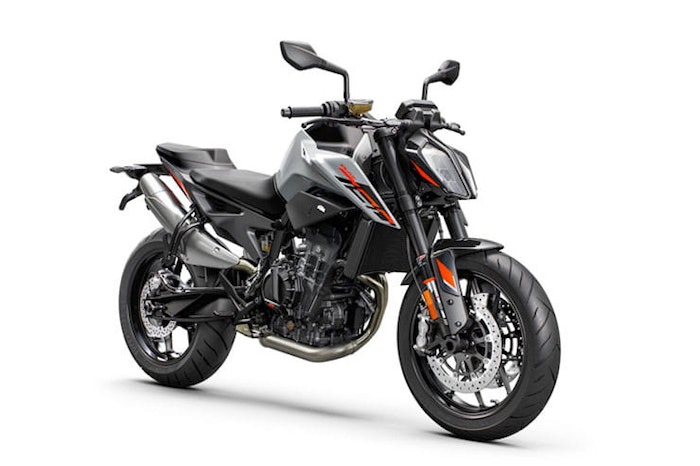
94bhp / 64.2lb-ft
187kg
CFMoto 675NK (2026) | Price: £6,499

94bhp / 64.2lb-ft
187kg
Honda CB650R (2026) | Price: £7999

94bhp / 51.6lb-ft
189kg

2026 Triumph Trident 660 - Verdict
The 2026 power hike makes one of Triumph’s most popular machines even more tempting, with the added bonus of improvements to the chassis and the ergonomics thrown into the mix along with a below-inflation price hike. The scalding hot level of competition in this category mean’s there’s a vast amount of choice, but thoughtful elements like the cornering ABS and traction control – all the more useful for the sort of newish riders who might be opting for the Trident – put it ahead of many rivals in the class.
If you’d like to chat about this article or anything else biking related, join us and thousands of other riders at the Bennetts BikeSocial Facebook page.
Do you already own a Triumph Trident 660? Tell us what it’s like, or ask us questions about it at bikeclub.bennetts.co.uk.

2026 Triumph Trident 660 - Technical Specification
| New price | From £8,095 |
| Capacity | 660cc |
| Bore x Stroke | 74mm x 51.1mm |
| Engine layout | Inline triple |
| Engine details | 12-valve, DOHC, 240-degree firing order, liquid-cooled |
| Power | 94bhp (70kW) @ 11,250rpm |
| Torque | 50.15lb-ft (68Nm) @ 8,250rpm |
| Transmission | 6-speed, chain drive, up/down quickshifter |
| Average fuel consumption | 57.6mpg claimed |
| Tank size | 14 litres |
| Max range to empty | 177 miles |
| Rider aids | Six-axis IMU, cornering ABS, cornering traction control, three riding modes |
| Frame | Steel tubular perimeter frame |
| Front suspension | Showa upside down SFF-BP forks, 41mm |
| Front suspension adjustment | N/A |
| Rear suspension | Showa monoshock |
| Rear suspension adjustment | Preload and rebound damping adjustable |
| Front brake | 2 x 310mm discs, two-piston Nissin sliding calipers, cornering ABS |
| Rear brake | 255mm disc, single piston sliding caliper, cornering ABS |
| Front wheel / tyre | 120/70 R 17 Michelin Road 5 |
| Rear wheel / tyre | 180/55 R 17 Michelin Road 5 |
| Dimensions (LxWxH) | 2024mm x 815mm x 1088mm |
| Wheelbase | 1402mm |
| Seat height | 810mm |
| Weight | 195kg (wet) |
| Warranty | 2 years/unlimited miles |
| Servicing | 10,000 miles/12 months |
| MCIA Secured Rating | Not yet rated |
| Website | www.triumphmotorcycles.co.uk |

What is MCIA Secured?
MCIA Secured gives bike buyers the chance to see just how much work a manufacturer has put into making their new investment as resistant to theft as possible.
As we all know, the more security you use, the less chance there is of your bike being stolen. In fact, based on research by Bennetts, using a disc lock makes your machine three times less likely to be stolen, while heavy duty kit can make it less likely to be stolen than a car. For reviews of the best security products, click here.
MCIA Secured gives motorcycles a rating out of five stars (three stars for bikes of 125cc or less), based on the following being fitted to a new bike as standard:
A steering lock that meets the UNECE 62 standard
An ignition immobiliser system
A vehicle marking system
An alarm system
A vehicle tracking system with subscription
The higher the star rating, the better the security, so always ask your dealer what rating your bike has and compare it to other machines on your shortlist.

Getting a motorcycle insurance quote with Bennetts is easy.
We compare prices from our panel of top-tier insurers, to find riders our best price for the cover they need. With common modifications covered as standard, our policies are rated Excellent on Trustpilot and 5 stars by Defaqto. We are an award-winning UK broker, with a UK-based contact centre and 24/7 claims support.
Buy direct or renew at bennetts.co.uk, or via our contact centre, to gain access to a free BikeSocial Membership - unlocking discounts on kit, tyres, training, and exclusive customer-only VIP experiences.


