Honda CBR600RR (2003-2006) - Review & Buying Guide


By Jim Moore
Bike journo for a quarter of a century
02.12.2025


£3200 - £4300
117bhp
169kg (dry)
4.5/5
Honda always had a minimum of one hand on the supersport crown since launching its ubiquitous CBR600F in 1987. From then and right through to the late 1990s the 600F proved to be the jack of all trades in the middleweight class. By the late ’90s, however, the supersport sector – and racing in particular – had become fiercer than ever, with rival manufacturers moving away from the class’s built-to-a-price roots. The gloves were off.
Come 2003 and Honda hit back. Hard. The CBR600RR was a radical departure from the old 600F’s do-it-all design. Honda’s sleek new 600 borrowed its styling and some chassis tech from the then new RC211V MotoGP bike and a focussed attitude from the infamous Fireblade. Packing a claimed 117bhp – not unleashed until the motor’s four 149.75cc pistons were spinning at a giddy 13,000rpm, weighing just 169 kilos dry and handling more like a lythe 400 than a middleweight, the 600RR proved an instant hit.
It owed little to the CBR600F, however, and even the sporty F Sport launched in 2001, with its business-like ergonomics centred around low clip-on ’bars, rear set ’pegs, and a modestly padded single seat. This was a 600 for the committed and for those who enjoy wringing every last drop of performance out of the bike beneath them. The fact that the CBR600RR has recently been reintroduced – a machine not that far removed from the 2003 original – and it’s again winning races, speaks volumes about the strength and effectiveness of the package.
If high rpm thrills, razor-sharp steering, and sublime handling are your thing, yet your budget can’t stretch to a modern middleweight, Honda’s early CBR600RR could well be the supersport thrill you’ve been looking for…
Pros & Cons
Timeless MotoGP styling that still look fresh 20 years on
Strong accessible performance from a proven inline-four engine
Nimble handling that works on both road and track
A glut of ex-race bikes making their way back onto the used market
Needs to be ridden hard – hard work if you’re not in the mood
Can use oil if subjected to a hard life
Honda CBR600RR (2003-2006) - Prices
2003 CBR600RR-3: All new supersport middleweight with MotoGP styling, deep set aluminium swingarm, underseat exhaust and arguably the finest handling in class. Colours: HRC red/black, black.
2004 CBR600RR-4: Addition of blue colour option the only update. Colours: HRC red, black, blue
2005 CBR600RR-5: Revised frame, new 45mm upside forks, radially mounted front calipers, and updated rear suspension linkages. Midrange performance improved thanks to redesigned inlet ports, dual stage fuel injection, a new exhaust system and mapping updates. Refreshed instruments. Overall, a 10kg reduction in dry weight. Colours: red/black/graphite, black/graphite, blue
2006 CBR600RR-6: No updates. Colours: red/black/graphite, black/graphite, blue
CBR600RR values:
Rough: £1200 - £2400
Tidy: £3200 - £3900
Mint: £4000 - £4300


Honda CBR600RR (2003-2006) - Engine & Performance
Honda stuck with its favoured supersport engine recipe for the 600RR, a 599cc across the frame inline-four. But while the basic architecture was the same as the previous CBR600F-S – even its 67 x 42.5mm bore and stroke was carried over – Honda gave the internals a radical overhaul.
Whereas the F-S was a road-focussed tool sprinkled with a few high-performance parts here and there to ease its transition to racing, the RR had its sights set on track success. Lighter internals coupled with a trimmed flywheel sharpened engine pick up, while a new Digital Stage Fuel Injection (DSFI) system replaced the F-S’s less sophisticated Programmed Fuel Injection (PGM-FI) set-up.
The most obvious difference between the F-S and RR in terms of mechanical componentry is the exhaust. Mimicking the RCV’s underseat silencer, the RR’s system winds its way from underneath the engine, up next to the right-side footrest, eventually exiting under the minimalist pillion seat. These tweaks and updates raised the engine’s power output from 109bhp of the F-S to 117bhp for the RR.
While there is more power, the RR has to be worked hard. Revs need to be kept north of 9000rpm to keep the motor on the boil, but when it’s singing it’s mightily effective for such a modest capacity. Later RRs are even peakier in their delivery so these earlier version are easier to ride on the road and arguably less frenetic to ride quickly on track – in other words you can afford to be a little lazier on a 2003-2006 CBR than a 2025 model, even if neither bike reacts that favourably to short-shifting.


Honda CBR600RR (2003-2006) - Handling & Suspension (inc. Weight)
Honda had already transitioned the CBR600 from steel framed all-rounder to aluminium chassis equipped mini superbike in 1998, but the 2003 CBR600RR was a far more radical proposition. The Big H was keen to underline the link between this new supersport contender and its then revolutionary RC211V MotoGP bike.
While the CBR’s engine didn’t mimic the RCV’s V5 layout, its frame, Honda claimed, used the same hollow aluminium die-cast technology, making it both light and strong. And at the rear of the CBR its Pro-Link monoshock system – held in check by a substantial, over-braced aluminium swingarm not dissimilar to that used on the Fireblade – utilised the same linkage set-up as the MotoGP bike. This kind of link with a blue-riband racing machine had not been seen in the supersport class before.
Dimensionally the RR was similar to the outgoing CBR600F-S – a kilo less weight, 15mm more on seat height, 3mm longer wheelbase for greater stability, as well as 8bhp extra performance. Up front the RR gained larger discs – up from 296mm to 310mm – and thicker 45mm forks, 2mm more generous than the F-S. Honda went further in 2005, ditching the conventional teles for upside-down forks of the same thickness (still stiffer by the nature of usd design) and radially-mounted front calipers.
Handling is a 600RR staple. The stiff, light chassis and track-focussed ergonomics – far more radical than any previous CBR600 – give the CBR pin-point steering, a front end that oozes feedback and feels better the harder it’s pushed, yet also a neutrality to its overall ride than makes it incredibly easy to ride fast. Its race results and popularity as a sporty road bike worldwide bear this out.


Honda CBR600RR (2003-2006) - What to look for
Cooling system: 600RRs can run hot in warm conditions, especially on track when the engine’s working hard, so it’s worth refreshing the coolant if the temp gauge runs high. Keep an eye on the temp when running in town or traffic, too. Generally only an issue in hotter climbs, however.
Reg/rec: It’s a Honda, so to be expected. Electrex World do replacements from just £107, so it’s an easy and affordable fix. Stators also have a reputation for failing, so give the electrics a thorough going over if you’re looking to buy. Wemoto supply stators from around £95.
Instruments: The rubber buttons on the clocks, that allow the clock to be changed and trip meter to be reset, perish over time, sometimes to the point that water ingress becomes a problem. Check that they work before handing over any cash because a complete change of clocks may well be the best cure.
Gearbox: Generally strong, but quickshifters (all aftermarket) can, if fitted incorrectly, cause the engagement dogs to wear prematurely. Has the bike been fitted with one before for trackday use? Get a test ride to check it will hold gears under load.
Engine: Again, a generally strong design, but early models have been known to use oil, so check for puffs of smoke on start up or the smell of oil. Ask the owner how often they’re having to top up engine lube.
Servicing: CBR600RR motors need to be worked to give their best – peak power doesn’t come into play until 13,000rpm so regular servicing and fresh oil is a must, particularly because these engines are now 20-plus years in age. Refresh the oil and filter every 4000 miles (more regularly if you’re taking it on track). Valve clearances need doing every 16K.
Ex-race bikes: CBR600RRs were the supersport race bike of choice in the early to mid-2000s, so quite a few that have seen action are likely to have seeped back onto the used market via the back door. Look for mismatched condition between the chassis components and bodywork, scuffed aftermarket pegs, chipped wheel rims, drilled fasteners and sump plugs – all the usual stuff.
Honda CBR600RR (2003-2006) - Rivals
Kawasaki ZX-6R: First year of Kawasaki’s all-new svelte ZX-6R and a serious match for the 600RR Honda. 636cc engine gives the Kawasaki more midrange grunt than the Honda in a package that’s only 5kg heavier. Overall finish isn’t as good as the Honda, so 20 year-old examples will be starting to look rough around the edges. Exciting to ride and generally cheaper to buy so well worth a look at. Also available as the 599cc RR race homologation version, but it lacks the 636cc model’s road friendly mid-rpm stomp.
Suzuki GSX-R600: A dead ringer for the better endowed GSX-R750 and even 1000, but makes do with budget suspension and lower-spec brakes. In fact the front brakes lacked bite from new, so if you’re after a track tool the CBR is better equipped. Better handling too. Like the Kawasaki the GSX-R’s finish is a rung below that of the Honda – furred aluminium and rusted steel components are to be expected. Suzuki owners love their aftermarket trinkets too, so expect the standard exhaust to be long gone, mini indicators to be in place of the originals and other add-ons of dubious taste to be front and centre.
Yamaha YZF-R6: The most powerful (claimed) 600 of its era and perhaps the CBR’s closest rival in terms of quality and performance. Roomier and more comfortable than the Honda, thanks to less radically positioned bars. A fine handler, although the R6’s front end doesn’t offer the confidence of the Honda’s. Commands slightly stronger money than the equivalent Kawasaki or Suzuki, but more of a bargain than the CBR in similar condition. Hasn’t aged as gracefully as the 600RR, but for bigger riders the Yamaha’s a no brainer.
Kawasaki ZX-6R, 2003 | Approx Price: £2500-£3400

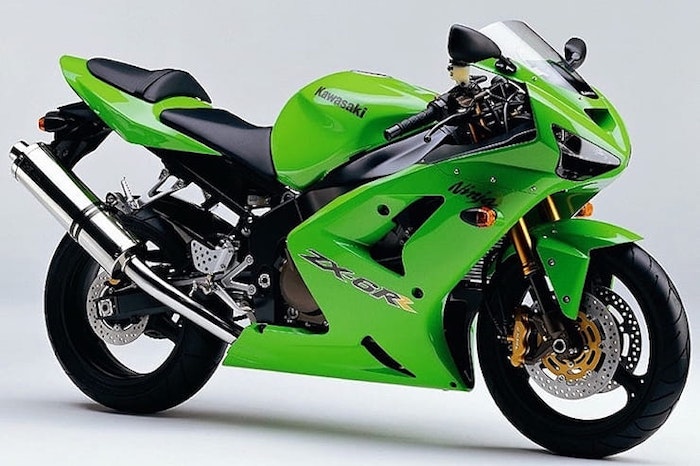
118bhp / 50.7lb-ft
174kg (dry)
Suzuki GSX-R600, 2003 | Approx Price: £2800-£3600

115bhp / 50.9lb-ft
163kg (dry)
Yamaha YZF-R6, 2003 | Approx Price: £2800-£3800

123bhp / 50.5lb-ft
162kg (dry)


Honda CBR600RR (2003-2006) - Verdict
The fact that the current CBR600RR isn’t that radically different from the 2003 model speaks volumes about the strength of the original’s design. Even now, 20-plus years on, this Honda still looks sharp, sleek and modern. What’s more, that modernity is matched in its performance and ride. As a sports bike with occasional trackday potential an early CBR600RR ticks a lot of boxes. And with tidy examples starting at just over £3K they’re still a hell of a lot of bike for the money. If any 600 deserves to be a modern classic it’s this.
If you’d like to chat about this article or anything else biking related, join us and thousands of other riders at the Bennetts BikeSocial Facebook page.


Honda CBR600RR (2003-2006) - Technical Specification
| Original price | £6799 |
| Current price range | £3200-£4300 |
| Capacity | 599cc |
| Bore x Stroke | 67mm x 42.5mm |
| Engine layout | liquid-cooled, DOHC, 16v inline-four |
| Power | 117bhp (87.2kW) @ 13,000rpm |
| Torque | 49.4lb-ft (64Nm) @ 11,000rpm |
| Top speed | 162.5mph |
| Transmission | 6-speed, wet multi-plate clutch, chain final drive |
| Average fuel consumption | 35 mpg |
| Tank size | 18 litres |
| Max range to empty (theoretical) | 138 miles |
| Reserve capacity | n/a |
| Rider aids | none |
| Frame | Aluminium beam |
| Front suspension | 45mm Showa telescopic forks |
| Front suspension adjustment | fully adjustable |
| Rear suspension | Showa monoshock |
| Rear suspension adjustment | fully adjustment |
| Front brake | 2 x 310mm discs, 4-pot caliper |
| Rear brake | 220mm disc, 1-pot caliper |
| Front tyre | 120/70 ZR 17 |
| Rear tyre | 180/55 ZR 17 |
| Rake/Trail | 24°/95mm |
| Dimensions (LxWxH) | 2065mm x 685mm x 1135mm |
| Wheelbase | 1389mm |
| Ground clearance | n/a |
| Seat height | 820mm |
| Dry weight | 169kg |

Getting a motorcycle insurance quote with Bennetts is easy.
We compare prices from our panel of top-tier insurers, to find riders our best price for the cover they need. With common modifications covered as standard, our policies are rated Excellent on Trustpilot and 5 stars by Defaqto. We are an award-winning UK broker, with a UK-based contact centre and 24/7 claims support.
Buy direct or renew at bennetts.co.uk, or via our contact centre, to gain access to a free BikeSocial Membership - unlocking discounts on kit, tyres, training, and exclusive customer-only VIP experiences.


