Yamaha Tracer 9 (2025) - Technical Review


By Ben Purvis
Motorcycle Journalist
29.10.2024


From £11,300
117.4bhp
212kg
TBA
Yamaha’s Tracer 9 – particularly in range-topping GT+ form – has already established itself as a leader in motorcycle technology and the latest model launched in 2025 brings significant upgrades that make it an even more sophisticated package.
While other brands pack their most exotic tech onto the heaviest, largest-capacity machines in their ranges, the Tracer 9 bucks the trend by offering a unique combination of all-the- bells-and-whistles into a much lighter, lither sports-touring package. For 2025 the GT and GT+ come with Yamaha’s Y-AMT semi-auto gearbox (optional on the GT, standard on the GT+) as well as the first adaptive matrix LED headlights to be offered on two wheels. The GT+’s radar system is uprated, too, gaining a rear blind spot monitoring system to accompany the existing front radar and adaptive cruise control.
Throw in some more comfort and improved aerodynamics and the Tracer 9 GT range looks like a very smart option for anyone wanting a manageable (very) sporty tourer.

Pros & Cons
Updates include improved aero and electric screen on GT and GT+ (addressing one of the few complaints about the previous generation)
Charismatic triple remains, now joined by Y-AMT transmission option
Adaptive cruise and hugely advanced radar-assisted braking system on GT+, now with added rear radar
Matrix LED headlights on GT and GT+ bring luxury car tech to two wheels for the first time
Er… Some might complain that you can’t get the GT+ (and hence the radar system) without the Y-AMT box. But try die-hard manual fans really should try the auto before dismissing it.


2025 Yamaha Tracer 9 - Price
Yamaha's 2025 Tracer 9 model range is spread across four distinct tiers.
The entry level Tracer 9 costs £11,004 and is available in Redline or Midnight Black.
The Tracer 9 GT is available either Ceramic Ice or Tech Black costs £13,954 (or the version fitted with the Y-AMT gearbox is an extra £1,000 at £14,954). Above that, the Tracer 9 GT+ model is only available with the Y-AMT system. Its price tag is £16,604 and it is available in either Cobalt Blue or Icon Performance, (a grey. black and blue combination).
With a PCP deal on a top-of-the-range Tracer 9 GT+ with a £4000 deposit you'd pay £170.97 for 36 months with a final payment of £8308.75 if you want to keep the bike. Interest is 5.9% APR.
For a basic Tracer 9 example numbers might be a £2750 deposit, £108.76 for 36 months and a £5567 final payment also at 5.9% APR
A three year-old Tracer 9 GT+ sells for around £10k in dealers at the moment, suggesting that at the end of your PCP the bike would cover itself and leave a little additional equity for your next one.


2025 Yamaha Tracer 9 - Engine & Performance
The Tracer 9's engine remains unchaged from the previous version, but now complies with the latest Euro5+ type-approval rules (which add requirements for emissions monitoring). Peak power remains at 119PS (117hp) at 10,000rpm – as does the max torque of 93Nm (68.6lbft) at 7000rpm. What has changed is that the bike now has improved electronics and the ability to program functions like engine braking from either the dash or Yamaha's MyRide app.
For an engine that can feel manic in the MT-09 and controllably sporty in the R9, it's surprising how well this motor also manages long distance, relaxed touring. Hammer it through the gears and you'll remember why everyone loves Yamaha's 893cc, CP3 engine. But after 200 miles of motorway in one hit, there are no tingly fingers and rider and pillion feel relaxed. Overtaking in top gear is easy enough, but knocking it down a cog is even more fun.
Surprisingly, for a triple, which are often sold on their smoothness and balance, there are some noticeable vibes if you grab the handguards on a motorway. Thankfully, the handlebars and bar-end weights isolate the rider well.
Yamaha's automated-manual Y-AMT transmission is an option on the Tracer 9 GT and standard on the GT+. This system adds two electromechanical actuators and computer-control to an otherwise standard manual transmission. Essentially the two actuators take on the jobs of your left hand and left foot. One modulates the clutch, the other shifts between the gears. Thanks to the combination of ride-by-wire that can match the throttle opening to the gear shifts, plus an IMU to monitor the bike’s attitude and angle, the system is intended to be able to change gears smoothly and at the right moment, while taking only a matter of milliseconds to actually accomplish the gearchanges.
There are two auto (AT) modes: ‘D’ for more relaxed riding, where the bike will shift up relatively early and keep the revs down, and ‘D+’ for a sportier approach, holding onto ratios longer to maximise performance. Alternatively, you instantly swap to the ‘MT’ manual setting, which lets you control the gearshifts via a seesaw trigger on the left bar. Upshifts are made by pulling the trigger with your forefinger, and downshifts can be achieved either by a push of the left thumb or by using the same forefinger to nudge the trigger in the other direction.
With no clutch lever, the bike is always in charge of when to engage or disengage it. As well as simplifying the job of riding the bike, Yamaha points out that the Y-AMT system lets you focus on other elements of riding, like body position and cornering, and that because you don’t have to worry about shifting gears with your foot, you’re able to better position that foot on the peg.
I've done a couple of thousand miles on Y-AMT-equipped MT-09s and MT-07s and am a fan - especiallyin Manual mode. I expected Y-AMT to be perfectly suited to the Tracer's multi-purpose riding and most of the time it was lovely. On long motorway runs I left in D+ and never thought about it. Manual mode works best on the back roads where you need to time overtakes in a way that the computer doesn't can't anticipate and the ride is much more 'involved'.
The surprise came in town and when filtering. I've ridden other Y-AMT bikes in these conditions but didn't notice how clumsy the gearchanges occasionally feel and I missed having control of the clutch slipping through narow gaps at low speed, aware of the panniers sticking out behind me.
It's never a real problem and the bike won't stall no matter how 'chuggy' the transmission gets. But it didn't feel like the ride of a bloke with 44 years' riding under his wheels and it distractd me. manual mode helped a little, but I'd still like to be able to slip my own clutch every now and then.
Also new to the Y-AMT-equipped models is Vehicle Hold Control, which automatically holds the brakes when you’re stationary on slopes.
All versions of the Tracer 9 get five riding modes – sport, street and rain presets plus two custom settings – and where the Y-AMT box is fitted they’re also integrated with its behaviour.


2025 Yamaha Tracer 9 - Handling & Suspension (inc. Weight)
The cast aluminium Deltabox frame itself is largely carried over from the previous Tracer 9 models, but the 2025 bike gets a longer rear subframe for additional rider and passenger comfort, that’s also lighter than the one it replaces.
As in the past, the GT and GT+ variants use a semi-active suspension setup with electronically adjustable damping that automatically reacts to lean angle, acceleration and load, an uses information from suspension stroke sensors to show how fast the forks and shock are compressing or extending. As with the engine and transmission, the semi-active suspension’s behaviour changes depending on the selected riding mode, with a firmer rider in ‘Sport’ and more comfort in ‘Street’ or ‘Rain’ modes.
The astounding level of integration of the system means that on the GT+, fitted with radar, the suspension damping is also automatically adjusted when the adaptive cruise control system accelerates or brakes. It’s also tied into the GT+’s radar-linked Unified Brake System, which automatically juggles front and rear brake pressure and uses the radar to monitor the distance to the vehicle ahead. If you don’t brake hard enough to prevent a collision, the system can automatically increase brake pressure to both wheels, and the adaptive suspension works alongside it to maximise stopping ability.
For those who worry about their bike 'braking for me', relax. The system won't apply the brakes independently, but if you are already braking and the radar detects you aren't slowing down quickly enough to avoid a collision it will add more pressure. Given that many riding instructors tell us their pupils don't come close to the limits of their bike's brake systems, that (in combination with the latest ABS systems) is a very smart feature.
The brakes themselves are the same 298mm front discs and four-pot radial calipers as before. As mentioned above they are paired paired to cornering ABS – part of a chassis electronics package that also includes lean-sensitive traction control, slide control and wheelie control, standard on all versions of the bike. and programmable in a couple of user-modes to tailor your Tracer to just how you like it.
Yamaha’s ‘Spinforged’ wheels help to reduce un-sprung and rotating masses. The weight savings even extend to the Bridgestone T32 tyres, developed specifically for the Tracer 9, helping to reduce front wheel weight by 200g and the rear by 300g.
A less obvious tweak is a change to the front fork bracket to increase steering lock and reduce the bike’s turning circle by 0.2 meters from 3.1m to 2.9m. That's especially helpful with Y-AMT because U-turns without a clutch are clumsy and riders may opt for a three-point turn. A smaller turning circle can at least make that a two-point turn
In base form, the 2025 Tracer 9 comes in at 212kg (1kg less than the 2024 version), but the added bells, whistles, luggage and Y-AMT of the GT and GT+ take that up to 227 and 232kg.


2025 Yamaha Tracer 9 - Comfort & Economy
The styling looks similar to the previous version but the 2025 Tracer 9’s bodywork is all-new with some key changes to improve the comfort of an already capable long-distance machine.
The seat subframe is 5cm longer than before to extend the space for rider and pillion. It’s topped by a flatter seat with more padding, and while the minimum seat height has increased from 810mm to 845mm thanks to the thicker pad, Yamaha claims that its shape – slimmer at the front than before – means the ‘stand-over distance’ is actually reduced, making it easier to get your feet flat on the floor.
At six-foot, the riding position is really comfortable for me. With the seat in the higher (15mm taller) position I can do two and a half hours on the motorway with no aches or pains in arms, neck or back and only minor grumbles from my knackered, ageing knees (which usually last 90 minutes on most bikes)
The GT and GT+ models come with heated grips as standard and there's a heated seat option too. There are three programmable settings for grips and seat and each has 10 levels of heat. The hottest settings are very, very warm.
One of the few niggles we found with the previous-gen Tracer 9 GT+ was its screen design, which could lead to buffeting, but the new model has a completely new screen that solves the problem completely in its highest position.
The standard Tracer's screen is manually adjustable, as on the previous bike, with a one-handed system that gives 50mm of movement spread across 10 increments. The GT and GT+ gain an electric screen with 100mm travel – adding 25mm at each end of its movement so it can be set lower or higher than the standard bike. I had a Pinlock fail at the start of a three hour motorway journey at 5am on a damp, foggy morning meaning I had to ride at 70mph with my visor up for most of the trip. It was suprisingly comfortable or at least bearable for what could have ben an awful experience.
With no massive changes to the engine, we’re not expecting the economy to be substantially different to the previous model, which achieved 44.1mpg during our last test.


2025 Yamaha Tracer 9 - Equipment
When it comes to kit, there’s no shortage on the Tracer 9, particularly if you head towards the GT or GT+ versions.
All the 2025 models get a new 7-inch TFT instrument panel, replacing both the unusual twin-dash setup of the last-gen bike and the single TFT of the previous GT+ model. With the choice of three themes, the new dash can show a vast amount of information including, on the GT and GT+, full map-based navigation via the Garmin Motorize app. The dash is also compatible with official options, so if you fit official heated grips or seat, for example, their status will be displayed on the screen.
As you’d expect, it’s also the main interface for all the bike’s tech, including the semi-active suspension and the Y-AMT transmission’s settings, on models where they’re fitted.
It’s on those high-end versions, the GT and GT+, that Yamaha’s world-first matrix LED headlights appear on the equipment list, and they’re a genuine step forward compared to rivals.
Matrix LEDs, which have been used on some high-end cars for a while, operate the headlights in cooperation with a front-facing camera that watches the road ahead, detecting things like light, weather conditions and oncoming vehicles to inform the headlights’ behaviour. As well as turning on and off automatically, matrix LED lights adapt to oncoming vehicles to prevent dazzling them while maximising the light on other parts of the road.
On a bike, there’s the added complication of the need to lean over, and here the matrix LED system means that the beam adjusts itself to suit the bike’s lean angle once over 7 degrees, again improving the view ahead in the dark. The base model also gets cornering lights, albeit not the matrix versions.
At the very top of the Tracer 9 range, the GT+ benefits from a forward-facing radar, as before, to allow adaptive cruise control and the Unified Braking System. For 2025, it works alongside the Y-AMT transmission, so can automatically adjust the bike’s speed over a broader range without the need for the rider to shift ratios. While KTM’s new AMT box, along with its own radar, allows its ACC to operate all the way to a complete standstill, the Yamaha adaptive cruise only works between 30km/h and 160km/h.
A rear-facing radar is a new addition for the 2025 Tracer 9 GT+, and as on other similarly-equipped bikes it enables blind-spot monitoring, with warnings that flash in the bike’s mirrors if there’s another vehicle lurking over your shoulder.
Yet more kit on the GT and GT+ models includes a Smart Key system that gives keyless access to the ignition, fuel filler, steering lock and the standard-fit side cases come with those models.
All versions also gain a new integrated storage area on the right-hand side of the fuel tank for 2025, purpose-made to hold a smartphone and complete with a built-in USB charging port.
2025 Yamaha Tracer 9 - Rivals
With the addition of a semi-auto transmission and even more advanced radar tech, not to mention the new matrix LED headlights and electronic suspension, the Tracer 9 GT+ in particular sports a level of tech that makes it hard to rival – at least without stepping up into a higher price and performance league. KTM’s brand new 1390 Super Adventure S Evo, for example, offers some similar functions but it’s expected to be substantially more expensive. The same applies to the BMW R1300GS, which similarly can be fitted with radar, BMW’s ASA auto transmission, adaptive cruise control and electronic suspension – but you’re in for more than £20k by the time you’ve reached that spec.
Opt for bikes with prices closer to the Tracer 9 GT+, like Kawasaki’s new Ninja 1100 SX or Suzuki’s GSX-S1000GX, and while you get a bit more power and performance, you can’t come close to the level of equipment.
Honda’s NT1100, particularly in its new-for-2025 Electronic Suspension form with DCT, is also worth a look – it has the most sophisticated of semi-auto transmissions, but lacks the radar options of the Yamaha and its Africa Twin based engine has less power.
Kawasaki Ninja 1100 SX SE | Price: £13,999


134.1bhp / 83.3ft-lb
234kg
Suzuki GSX-S1000GX | Price: £14,799

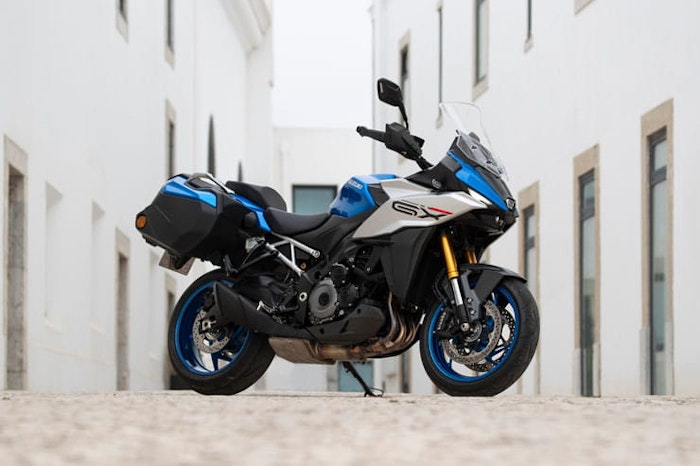
150bhp / 78.2ft-lb
232kg
Honda NT1100 DCT ES | Price: £14,099

100.6bhp / 82.6ft-lb
249kg


2025 Yamaha Tracer 9 - Verdict
Once we’ve had a chance to ride the new Tracer 9 GT+ we’ll update this review to let you know all the details.
If you’d like to chat about this article or anything else biking related, join us and thousands of other riders at the Bennetts BikeSocial Facebook page.
Do you own a current Tracer 9 GT? Tell us what you like, dislike or ask us questions about it at bikeclub.bennetts.co.uk.


2025 Yamaha Tracer 9 - Technical Specification
| New price | Tracer 9: £11,300 Tracer 9 GT: £14,350 Tracer 9 GT Y-AMT: £15,350 Tracer 9 GT+ Y-AMT: £17,000 |
| Capacity | 890cc |
| Bore x Stroke | 78mm x 62.1mm |
| Engine layout | Inline triple |
| Engine details | Liquid-cooled, 4-stroke, 4-valves, 3-cylinder, DOHC |
| Power | 117.4bhp (87.5kW) @ 10,000rpm |
| Torque | 69 ft.lb (93Nm) @ 7000rpm |
| Transmission | 6 speed, chain final drive, assist and slipper clutch, optional Y-AMT semi-auto |
| Average fuel consumption | 56.5mpg |
| Tank size | 19-litre |
| Max range to empty | 236-miles |
| Rider aids | Cornering traction control, cornering ABS, slide control, wheelie control, brake control. GT+ includes radar-assisted adaptive cruise control and unified braking system. Y-AMT models have vehicle hold control |
| Frame | Cast aluminium Deltabox |
| Front suspension | KYB USD forks |
| Front suspension adjustment | Preload and rebound, electronic damping adjustment on GT and GT+ models |
| Rear suspension | KYB shock |
| Rear suspension adjustment | Preload and rebound, electronic damping adjustment on GT and GT+ models |
| Front brake | 298mm discs, four-piston radial calipers |
| 245mm disc, single piston caliper | |
| Rear brake | 245mm disc, single piston caliper |
| 180/55 ZR17 Bridgestone Battlax T32 | |
| Front wheel / tyre | 120/70 ZR17 Bridgestone Battlax T32 |
| Rear wheel / tyre | 180/55 ZR17 Bridgestone Battlax T32 |
| 845mm-860mm | |
| Dimensions (LxWxH) | 2175 x 900 x 1460-1505mm |
| Wheelbase | 1500mm |
| Seat height | 845mm-860mm |
| Weight | From 212kg |
| Warranty | 2 years |
| Servicing | TBC |
| MCIA Secured Rating | Not yet rated |
| Website | www.yamaha-motor.eu |

What is MCIA Secured?
MCIA Secured gives bike buyers the chance to see just how much work a manufacturer has put into making their new investment as resistant to theft as possible.
As we all know, the more security you use, the less chance there is of your bike being stolen. In fact, based on research by Bennetts, using a disc lock makes your machine three times less likely to be stolen, while heavy duty kit can make it less likely to be stolen than a car. For reviews of the best security products, click here.
MCIA Secured gives motorcycles a rating out of five stars (three stars for bikes of 125cc or less), based on the following being fitted to a new bike as standard:
A steering lock that meets the UNECE 62 standard
An ignition immobiliser system
A vehicle marking system
An alarm system
A vehicle tracking system with subscription
The higher the star rating, the better the security, so always ask your dealer what rating your bike has and compare it to other machines on your shortlist.


